
Saucony Trail Running Guide
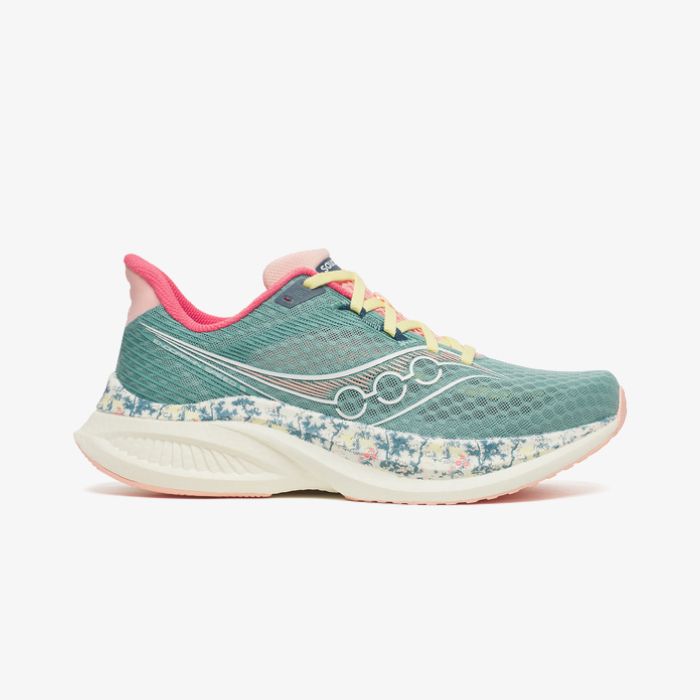 PWRRUN PB technology with 88% energy return">
Written by: Chris O'Dea
Published: February 2026
Reading time: ~6 minutes
This is a supporting guide to our main Saucony Brand Guide. It focuses specifically on Saucony's trail running range — the Peregrine, Xodus Ultra, and entry-level trail models. This guide covers terrain suitability, outsole technology, rock plate protection, Gore-Tex trade-offs, and how to choose the right trail shoe.
Saucony's Trail Philosophy
Saucony's trail range is built around two principles: ground connection and mountain-readiness. Where some brands pursue maximalist stack heights that isolate the foot from terrain, Saucony's trail shoes maintain a lower, more agile profile that preserves ground feel while providing targeted protection. The Peregrine — named after the fastest bird in the world — anchors this philosophy and has done so for sixteen generations.
The trail lineup is small by design. Saucony does not attempt to cover every niche. Instead, it offers three tiers: a technical all-mountain shoe (Peregrine), a max-cushion ultra-distance shoe (Xodus Ultra), and an accessible road-to-trail crossover (Blaze TR / Ride TR). Each serves a distinct terrain profile and runner type.
The Peregrine 16
The Peregrine is Saucony's flagship trail shoe. Version 16 represents the most significant update in the model's history, introducing a full Vibram Megagrip outsole and increasing the stack height by 4mm over the previous generation.
The midsole uses PWRRUN — an injected EVA blend that is firmer and more stable than the PEBA-based foams found in Saucony's road racing range. This is deliberate. On uneven terrain, the predictability and lateral stability of a firmer foam outperform the soft, bouncy characteristics that make PEBA effective on flat roads. A PWRRUN+ sockliner sits above the midsole, adding a layer of beaded TPU for step-in comfort without compromising the structural integrity of the platform beneath it.
The switch from Saucony's proprietary PWRTRAC rubber to Vibram Megagrip is the defining change in version 16. Megagrip provides significantly better grip on wet rock and slick surfaces — the primary weakness of previous Peregrine models. The lug depth has decreased from 5mm to 4mm in the transition, which slightly reduces bite in deep mud but improves performance on hard-packed trails and rocky terrain where shorter, stiffer lugs maintain better ground contact.
A forefoot rock plate sits between the outsole and midsole, shielding the metatarsals from sharp stone impacts. The plate is flexible rather than rigid, allowing the forefoot to articulate over roots and uneven surfaces without creating a stiff, unresponsive dead zone. The heel does not have a rock plate, relying instead on the midsole depth for impact absorption.
The Peregrine 16 includes a D-ring at the heel for gaiter attachment, a gusseted tongue to prevent debris entry, and a reinforced toe bumper. It runs true to size with a secure midfoot and heel lockdown, though the toe box is trimmer than ultra-distance models — adequate for runs up to marathon distance but potentially restrictive over longer efforts where foot swelling becomes a factor.
The Xodus Ultra 4
The Xodus Ultra is Saucony's max-cushion trail shoe, engineered for ultra-distance running over rocky, technical terrain. Where the Peregrine prioritises ground feel and agility, the Xodus Ultra prioritises sustained comfort and protection over many hours on feet.
The midsole uses a dual-density construction: a core of PWRRUN PB (the same PEBA-based foam found in Saucony's road racing range) surrounded by a structural frame of firmer PWRRUN. This combination provides the soft, bouncy energy return that reduces leg fatigue over distance, while the outer frame prevents the lateral instability that pure PEBA midsoles can create on uneven ground. A PWRRUN+ sockliner adds further step-in cushioning.
Like the Peregrine 16, the Xodus Ultra 4 now features a full-coverage Vibram Megagrip outsole — a first for this model. Previous versions used Saucony's in-house rubber with a midfoot cutout to reduce weight. The full-coverage Vibram adds weight (the shoe comes in at approximately 309g for a US men's 9) but dramatically improves traction and durability across the entire foot. The 4mm lugs are angled for multi-directional grip on loose gravel, steep switchbacks, and wet rock.
The broader toe box accommodates the foot swelling that occurs during ultra-distance efforts. The 6mm heel-to-toe drop is higher than the Peregrine's 4mm, providing a more road-like transition that many ultra runners prefer during the later stages of long races when running form deteriorates. D-ring gaiter attachment and a padded collar complete the long-distance feature set.
Entry-Level Trail: Blaze TR and Ride TR
The Blaze TR serves as an accessible entry point for runners transitioning from road to trail. It uses a PWRRUN midsole with an 8mm drop — closer to road shoes than the Peregrine's 4mm — making it feel familiar to runners accustomed to daily trainers like the Ride or Guide. It does not include a rock plate, relying on midsole depth alone for underfoot protection. The lugged rubber outsole provides basic grip on groomed trails and gravel paths but lacks the bite for technical terrain.
The Ride TR offers a similar road-to-trail hybrid approach using a PWRRUN+ midsole for a plusher, more forgiving ride. Both models suit park trails, canal paths, and light off-road commutes rather than mountain running.
Model Specifications
| Specification | Peregrine 16 | Xodus Ultra 4 | Blaze TR |
|---|---|---|---|
| Stack Height | 32mm / 28mm | 36mm / 30mm | 35.5mm / 27.5mm |
| Heel-to-Toe Drop | 4mm | 6mm | 8mm |
| Weight (US Men's 9) | ~269g | ~309g | ~283g |
| Midsole Foam | PWRRUN | PWRRUN PB core / PWRRUN frame | PWRRUN |
| Outsole | Vibram Megagrip | Vibram Megagrip | Lugged Rubber |
| Lug Depth | 4mm | 4mm | ~4mm |
| Rock Plate | Yes (forefoot) | Yes | No |
| Intended Terrain | Technical / All-Mountain | Ultra-Distance / Rocky | Groomed / Road-to-Trail |
Gore-Tex vs Non-GTX
The Peregrine 16 and Xodus Ultra 4 are both available in Gore-Tex (GTX) waterproof versions. The GTX membrane prevents water entry from external sources — rain, wet grass, shallow puddles, and snow. This makes GTX versions effective for winter trail running and cold, wet climates where keeping feet dry directly affects warmth and safety.
The trade-off is breathability. Gore-Tex restricts airflow, which means feet run hotter in warm conditions. More critically, if water enters a GTX shoe from above — a deep stream crossing or ankle-deep mud — it cannot drain. The membrane that keeps water out also keeps water in. Non-GTX versions with mesh uppers allow water to enter but also drain and dry rapidly, making them superior for summer trail running, fell running in streams, and any route involving water crossings.
For UK trail running, GTX is most useful between October and March when cold rain and saturated ground are constant. Between April and September, non-GTX models are generally more practical unless running exclusively on dry, non-technical terrain.
Choosing the Right Trail Shoe
The Peregrine 16 suits runners who want agility and ground feel on technical terrain. Its lower stack, 4mm drop, and forefoot rock plate make it responsive on rocky singletrack, rooty forest trails, and mountain paths up to marathon distance. It is the correct choice for runners who prioritise nimbleness and trail feedback over maximum cushioning.
The Xodus Ultra 4 suits runners covering long distances on rough ground. Its PEBA-core midsole and higher stack absorb cumulative impact over many hours, while the wider toe box accommodates foot swelling. It is the correct choice for ultra-distance events, long mountain days, and runners who need sustained protection rather than speed.
The Blaze TR and Ride TR suit runners who split time between road and trail. Their higher drops and road-like transitions feel familiar to daily trainers, and their simpler outsoles handle groomed paths without the aggressive traction that would feel harsh on tarmac sections. They are not designed for technical terrain.
Trail Shoe Care
Trail shoes degrade faster than road shoes due to abrasive terrain, mud exposure, and repeated wet-dry cycles. Allow mud to dry fully before brushing it off — scrubbing wet mud pushes grit into mesh fibres, accelerating wear. Remove sockliners after every wet run and air dry at room temperature away from direct heat sources. For GTX models, refresh the external DWR (Durable Water Repellent) coating with a technical spray when water no longer beads on the surface.
Replace trail shoes when lug depth has worn below approximately 2mm, as traction on wet and loose surfaces deteriorates significantly beyond this point. Most runners report effective traction life of 300–500 miles depending on terrain abrasiveness.
Editorial Integrity
This supporting guide was written by Chris O'Dea and maintained by OD's Designer Clothing. It is independent editorial content created to support informed purchasing decisions.
Version: 1.0
Last reviewed: February 2026
Browse men's Saucony or women's Saucony at OD's Designer Clothing.
Shop the Range at OD's
Browse our curated selection below, or view the full collection at OD's Designer Clothing.
Frequently Asked Questions
Which Saucony trail shoe is best for UK fell running?
The Peregrine 16 is the best choice for UK fell running. Its Vibram Megagrip outsole delivers significantly better grip on wet rock than previous models, and its 4mm drop and forefoot rock plate suit technical terrain.
Is the Peregrine 16 GTX worth it?
For UK trail running between October and March, the GTX version is highly practical. It keeps feet dry in cold rain and saturated ground. In summer, non-GTX models are better as they drain and dry faster.
How long do trail running shoes last?
Most runners report effective traction life of 300 to 500 miles depending on terrain. Replace trail shoes when lug depth wears below approximately 2mm, as grip deteriorates significantly beyond that point.
What is the difference between Peregrine and Xodus Ultra?
The Peregrine prioritises agility and ground feel on technical terrain up to marathon distance. The Xodus Ultra prioritises sustained cushioning over ultra distances with a wider toe box for foot swelling. The Xodus uses a PEBA core midsole for additional energy return.
Can I use the Blaze TR on technical trails?
The Blaze TR is designed for groomed paths, canal towpaths, and light off-road use. It does not include a rock plate and its outsole lacks the bite for technical terrain. For rocky or steep trails, choose the Peregrine or Xodus Ultra.